Project Overview
This investigation analyzed web application log activity to identify possible brute-force and suspicious login behavior. The review focused on repeated login-page requests, credential submission patterns, account creation activity, and repeated requests from the same source IP.
Objective
The objective was to determine whether the observed web requests represented normal user activity or suspicious authentication-related behavior consistent with brute-force attempts or login abuse.
- Repeated access to the login page
- Suspicious credential submission patterns
- Account creation flow activity
- Repeated requests from the same source IP
- Attacker behavior before and after login attempts
Investigation Timeline
Log Source
The investigation was based on web log entries showing repeated activity from source IP 234.161.112.162. Evidence screenshots also show repeated login attempts from source IP 146.241.73.240, which should be reviewed as part of the same authentication-abuse pattern.
Key Indicators Observed
Investigation Analysis
The logs showed repeated access to /login and requests containing credential parameters such as uid=test&pw=test. Credentials appearing directly in URL parameters are suspicious because they may indicate insecure handling, attacker-driven testing, or scripted authentication abuse.
The same source also accessed account creation and profile creation functionality, including requests containing values such as action=new, uid=test, pw=test, and is_author=True. This suggested that the actor was not only testing login access, but also account creation or privilege-related behavior.
Analyst Notes
The activity pattern was not limited to one failed login attempt. The sequence included repeated authentication requests, account-related pages, and profile creation behavior, which increased suspicion that the actor was testing application authentication and user-management controls.
Even without confirmed account compromise, this behavior should be documented because brute-force attempts and login abuse often precede unauthorized access or privilege escalation attempts.
MITRE ATT&CK Mapping
- T1110 - Brute Force
- T1078 - Valid Accounts, if the actor successfully authenticates
- Possible account manipulation concerns if user creation or privilege-related parameters are abused
Final Verdict
Suspicious Activity - Brute-Force / Login Abuse Detected
The activity was assessed as suspicious because it involved repeated authentication-related requests, credential submission attempts, and abnormal account-related behavior from the same source IP.
Recommended Remediation Actions
- Enforce account lockout or rate-limiting controls
- Prevent credentials from being transmitted in URL parameters
- Review account creation and privilege assignment logic
- Monitor for repeated login failures or repeated requests from a single IP
- Block or challenge suspicious IPs if behavior continues
- Review logs for any successful account creation or unauthorized access
Lessons Learned
- Repeated login activity from a single source can indicate brute-force or testing behavior.
- Credentials in URLs are a security weakness and a strong investigation clue.
- Account creation flows should be monitored for abuse.
- Authentication logs are critical for detecting attacker behavior early.
- Even unsuccessful login abuse attempts should be documented and reviewed.
Investigation Evidence
Selected screenshots from the investigation workflow. These visuals support the written analysis and help show the investigation process.
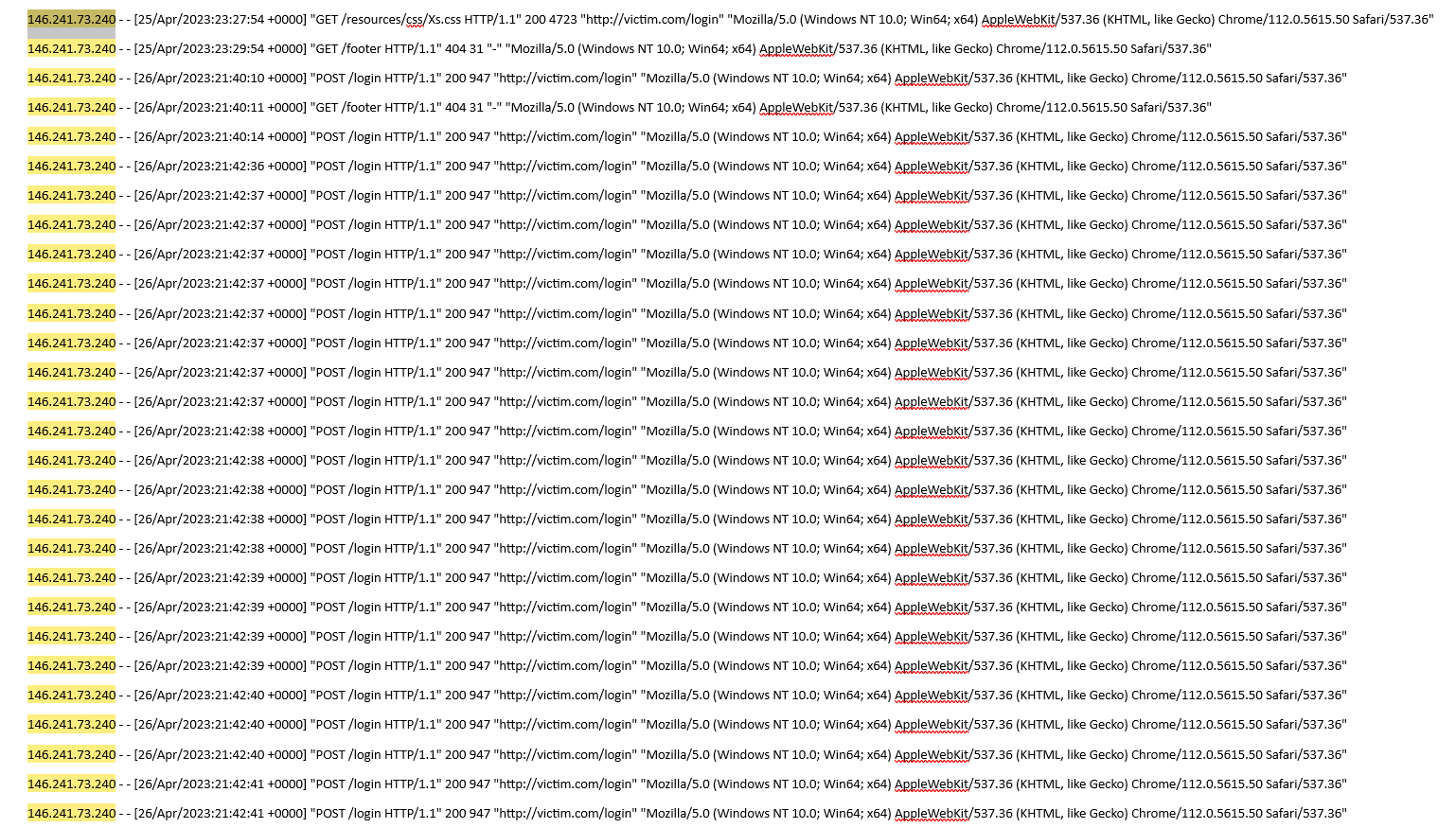
Repeated POST /login requests over a short time window, consistent with brute-force or login abuse behavior.