Alert Summary
An inbound phishing alert was triggered after a suspicious email reached a user inbox without being blocked. The message was sent from free@coffeeshoop.com to felix@letsdefend.io through SMTP source 103.80.134.63 with the subject line Free Coffee Voucher.
Investigation Timeline
This timeline summarizes the investigation workflow from alert review through classification and containment recommendation.
Email Analysis
The phishing email leveraged social engineering techniques, including urgency and reward-based lures, to increase the likelihood of user interaction. Phrases such as Hurry and This offer expires soon supported the assessment that this was a deceptive message rather than a normal promotional email.
Header Findings
- Sender:
free@coffeeshoop.com - Recipient:
felix@letsdefend.io - SMTP Source IP:
103.80.134.63 - Subject:
Free Coffee Voucher - Delivery Status: Allowed
- Severity: Medium
IOC Analysis
The main indicators reviewed during the investigation included the sender, source IP, lure subject, suspicious attachment or URL behavior, and impersonation indicators.
Threat Intelligence Review
The suspicious URL or related artifact was reviewed using external threat intelligence. Multiple detections supported the conclusion that the activity was malicious. Supporting analysis indicated that the URL imitated an Adobe login page and that the attachment behavior aligned with a malicious remote-access malware pattern.
Analyst Notes
The delivery status of Allowed increased the user risk exposure because the phishing email successfully reached the mailbox without initial containment by email security controls.
The combination of a deceptive sender, urgency-based language, suspicious artifacts, and threat intelligence enrichment supported escalation from suspicious activity to a confirmed true positive phishing attempt.
Detection Opportunities
Based on the investigation, the following areas could improve future detection or prevention:
- Email gateway filtering for suspicious sender domains and promotional lures from low-reputation infrastructure
- URL reputation blocking for known malicious or newly suspicious links
- Attachment sandboxing for ZIP files and payload-like behavior
- User phishing awareness focused on urgency, fake rewards, and credential harvesting attempts
- Domain and IP reputation monitoring for recurring phishing infrastructure
- Mailbox search workflows to identify similar messages across the environment
User Risk
Because the email was delivered successfully, the recipient was exposed to multiple possible risks:
- Credential theft through fake login capture
- Malware execution if the attachment was opened
- Initial access into the environment
- Follow-on attacker activity after user interaction
MITRE ATT&CK Mapping
- T1566 - Phishing
- T1566.001 - Spearphishing Attachment
- T1566.002 - Spearphishing Link
- T1204 - User Execution
- Credential harvesting through a deceptive login page
Final Verdict
True Positive - Phishing Attempt
The alert was classified as malicious because it combined a deceptive sender, urgency-driven content, suspicious artifacts, and supporting threat intelligence indicating phishing and malware delivery behavior.
Containment Recommendation
- Quarantine or remove the email from affected mailboxes
- Block the sender address and related domain if confirmed malicious
- Block associated URLs and file indicators
- Contact the recipient to confirm whether they clicked the link or opened the attachment
- Search for similar phishing messages across the environment
- Update detections and user awareness guidance as needed
Lessons Learned
- User awareness remains critical against phishing campaigns that use urgency and reward-based lures.
- Threat intelligence enrichment improved triage confidence and supported accurate classification.
- Early IOC validation helped reduce investigation time and supported faster containment recommendations.
- Allowed delivery status should be reviewed carefully because it increases the chance of user interaction.
Investigation Evidence
Selected screenshots from the phishing investigation workflow. These visuals support the written analysis and help show the investigation process.
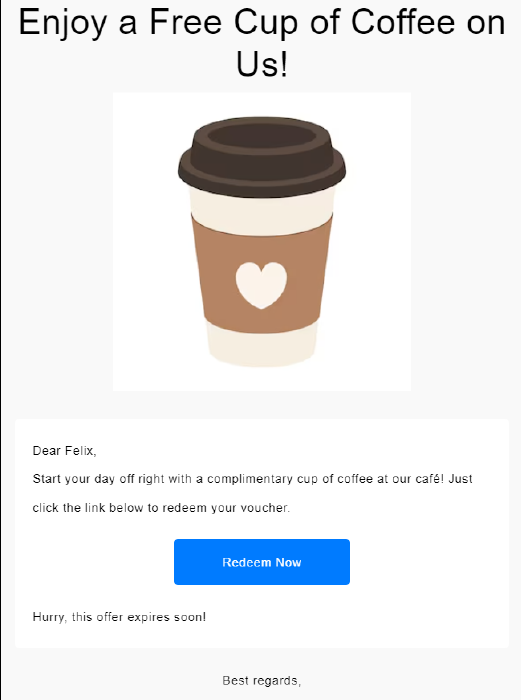
Suspicious phishing email delivered to the user inbox.
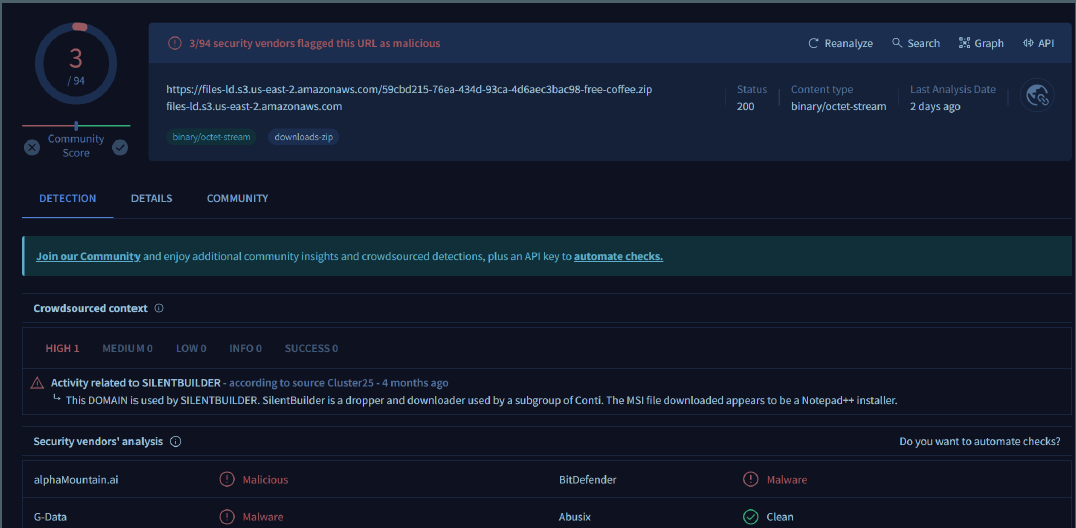
Threat intelligence enrichment and URL analysis results.
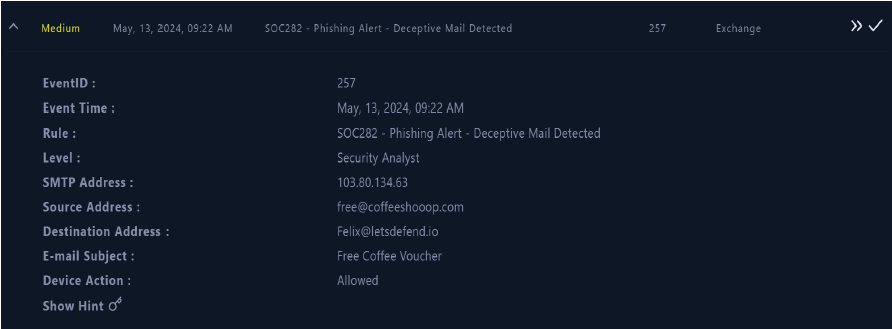
SOC alert summary and investigation workflow evidence.